
The H-2A visa is a temporary worker program that allows U.S. employers to bring foreign nationals to the United States to fill temporary or seasonal agricultural job openings when qualified U.S. workers are not available. H-2A covers agricultural work, farming, harvesting, livestock, poultry, dairy, and related activities. Employers must obtain Department of Labor certification and USCIS petition approval before workers may be admitted.

H-2A status may be extended if the temporary agricultural need continues beyond the originally certified period. Extensions require a new or amended DOL labor certification reflecting the extended period and an amended I-129 petition with USCIS. Each extension is evaluated on its merits; USCIS does not automatically grant extensions simply because prior petitions were approved.
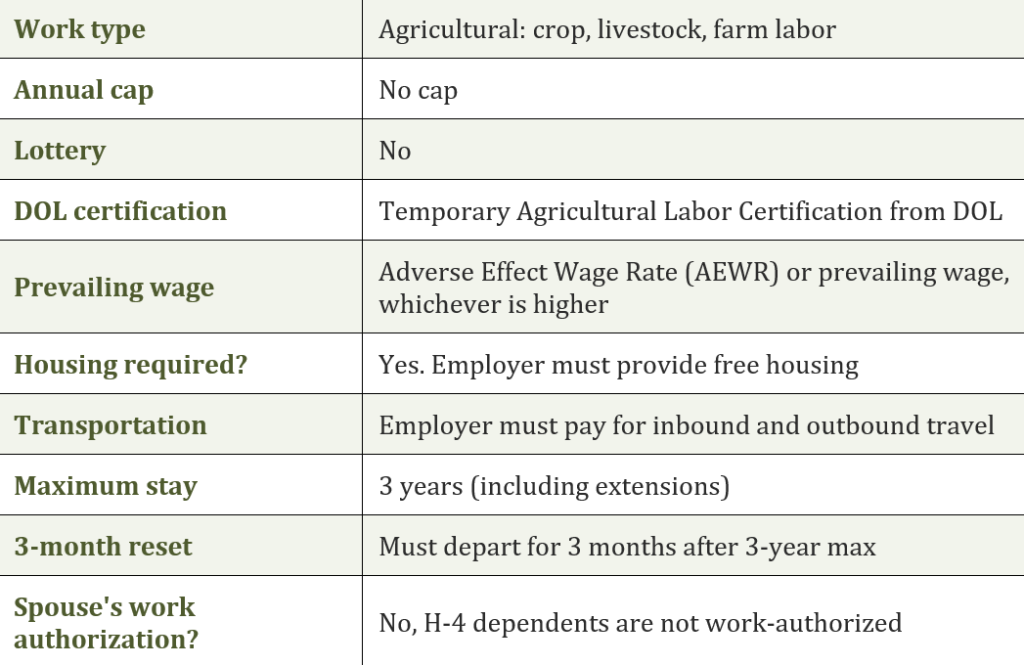
The maximum stay in H-2A status, including all extensions, is 3 years. After 3 years, the worker must depart the U.S. and reside outside the U.S. for an uninterrupted period of at least 3 consecutive months before a new H-2A petition may be approved.
Change of status for H-2A workers is less common than for professional visa categories because most H-2A workers are recruited from abroad and return home between contract periods. However, COS is available to workers with valid non-immigrant status who have a qualifying employer willing to file the appropriate petition.
H-2A status is strictly temporary and employer-specific. Workers should not plan to use this category as a gateway to permanent residence. Overstaying or working outside the scope of the petition results in unlawful presence and can trigger multi-year bars to future U.S. admission.
H-2A is for temporary agricultural workers, farmworkers, crop pickers, livestock workers, loggers, and other agricultural laborers. It has no annual numerical cap, and workers do not need a specific educational credential. H-2B, by contrast, is for temporary non-agricultural workers and has an annual cap of 66,000 visas, frequently requiring a lottery when demand exceeds availability.
The Department of Homeland Security (DHS) publishes an annual list of eligible countries for the H-2A program. Nationals of countries not on the list may still be considered on a case-by-case basis if the employer can demonstrate it is in the US interest. In recent years, the list has included approximately 80 countries. The list is updated annually, and employers should verify current eligibility before recruiting.
No. H-2A agricultural worker visas are exempt from the annual numerical cap. Employers can petition for as many H-2A workers as their certified need demonstrates, at any time of year. This cap exemption reflects the critical and time-sensitive nature of agricultural labor and the perennial domestic shortage of workers willing to perform agricultural tasks under H-2A conditions.
Yes. Spouses and unmarried children under 21 may accompany H-2A workers on H-4 dependent visas. H-4 dependents are NOT authorized to work in the US. If a dependent wishes to work, they must independently qualify for and obtain a separate work-authorized visa status. There is no mechanism for H-4 dependents of H-2 workers to obtain Employment Authorization Documents (EADs).
H-2A covers work on a farm or ranch in crop production (planting, cultivating, harvesting), livestock and dairy operations, poultry processing, Logging operations, and related activities that are part of the agricultural production process. It also covers agricultural services, such as contract farm work, irrigation, and land preparation, performed on a farm or ranch.
H-2A employers are legally required to provide free housing to workers who cannot reasonably return to their residence at the end of each workday. The housing must meet applicable federal and state safety and health standards. Employers must also provide free transportation between the housing and the worksite and must pay or reimburse inbound travel costs from the worker’s home country once the worker has completed 50 percent of the contract period. Outbound return transportation must also be provided when the worker completes the contract or is dismissed without cause.