
The E-3 visa is a non-immigrant work visa exclusively available to Australian citizens seeking employment in the United States in a specialty occupation. Created by the US-Australia Free Trade Agreement Implementation Act of 2005, the E-3 has many similarities to the H-1B, both require a specialty occupation and a bachelor's degree, but offers significant practical advantages including no effective cap, faster processing, lower fees, and automatic work authorization for spouses.

The E-3 cap has never been exhausted since the visa's creation in 2005. With only around 4,000 to 5,000 visas used annually against a 10,500 allocation, Australian professionals can apply at any time without lottery risk, a major advantage over the H-1B.
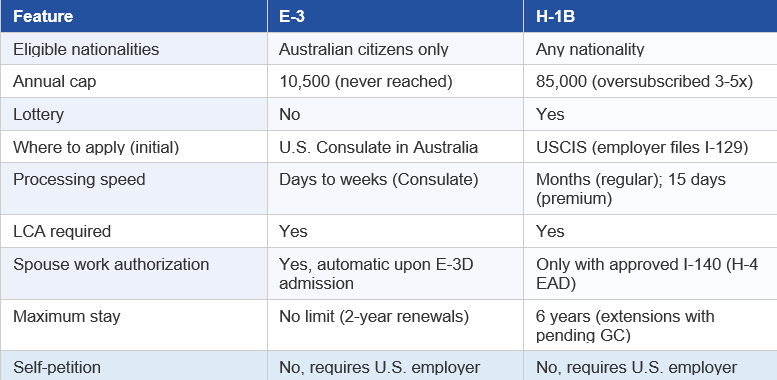
E-3 status can be renewed an unlimited number of times in up to 2-year increments. There is no statutory maximum on total time in E-3 status, making it one of the few U.S. work visa categories without a hard time limit. The primary practical constraints are continued specialty occupation employment, continued Australian citizenship, a valid employer offer, and an LCA for each renewal period.
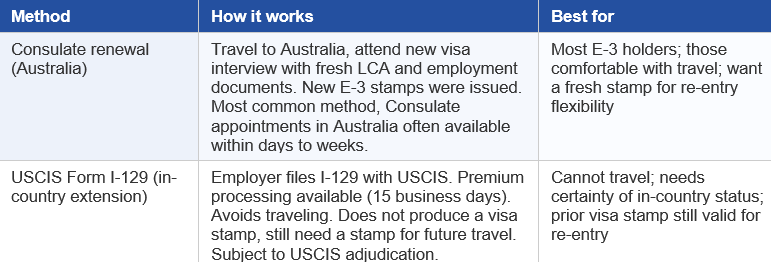
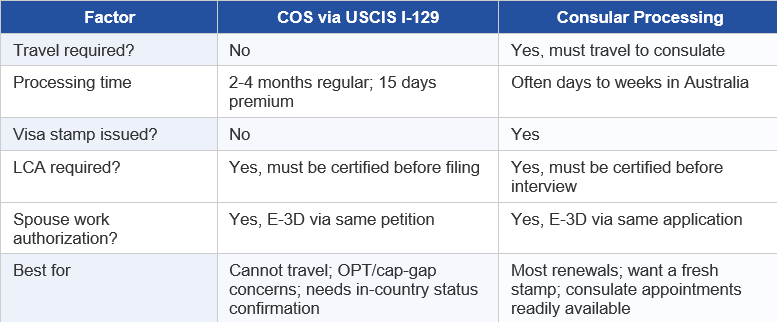
An Australian citizen already in the U.S. in valid non-immigrant status may request a change of status to E-3 by having the employer file Form I-129 with USCIS. This avoids travel to Australia for a consulate appointment. The status change takes effect on the USCIS approval date shown on the I-797 notice. The LCA must be certified before the I-129 is filed.
A COS approval does not produce a visa stamp. The E-3 holder will need to visit a US Consulate, typically in Australia, to obtain an E-3 visa stamp before any international travel and re-entry to the U.S. For E-3 holders who travel frequently, consular renewal is usually more practical than in-country COS.
The E-3 visa is exclusively available to Australian citizens. Australian permanent residents and nationals of other countries are not eligible, regardless of Australian residency. The applicant must also have a legitimate offer of employment in the US in a specialty occupation — defined as a position requiring theoretical and practical application of highly specialized knowledge and a minimum of a bachelor’s degree (or its equivalent) in a specific field. This is the same specialty occupation standard as the H-1B.
Yes, but it has never been reached. Congress authorized 10,500 E-3 visas per fiscal year exclusively for Australian nationals. Due to relatively low demand, the cap has never been fully utilized, meaning E-3 visas have effectively been available year-round without waitlists or lottery. This is a significant practical advantage over the H-1B, which is capped at 85,000 and oversubscribed by a factor of 3 to 5 each year.
A specialty occupation requires at least a US bachelor’s degree (or foreign equivalent) in a specific field that is directly related to the position. Common qualifying occupations include software engineering, IT, finance, accounting, marketing, architecture, engineering disciplines, science, law, medicine, and management consulting. The employer must demonstrate both that the role requires a specialized degree and that the applicant holds that degree or its equivalent in education and experience.
Yes. Spouses and unmarried children under 21 may accompany the E-3 holder on E-3D (dependent) visas. Uniquely among US work visa dependent categories, E-3D spouses are automatically work-authorized upon admission — no separate EAD application is needed, although an EAD can be obtained as documentary proof. E-3D children are not work-authorized. Dependents do not need to be Australian citizens.
Technically no. The E-3 is a non-immigrant visa and does not carry formal dual-intent designation. In practice, USCIS and consular officers generally allow E-3 holders to pursue permanent residence concurrently, particularly where an I-140 immigrant petition has been filed. However, because the E-3 requires demonstration of non-immigrant intent at each renewal, individuals with pending green card applications should seek legal advice before each consular renewal to address potential immigrant intent issues.
Both require a specialty occupation and a bachelor’s degree. Key E-3 advantages: no lottery, effectively no cap, faster processing (consulate same-week appointments are common in Australia), lower fees, and spouse work authorization. Key H-1B advantages: explicit dual-intent, greater employer flexibility (H-1B transfers are straightforward), longer maximum stay (6 years plus AC21 extensions vs no statutory E-3 maximum but renewal-dependent), and wider availability (all nationalities vs Australian citizens only).