
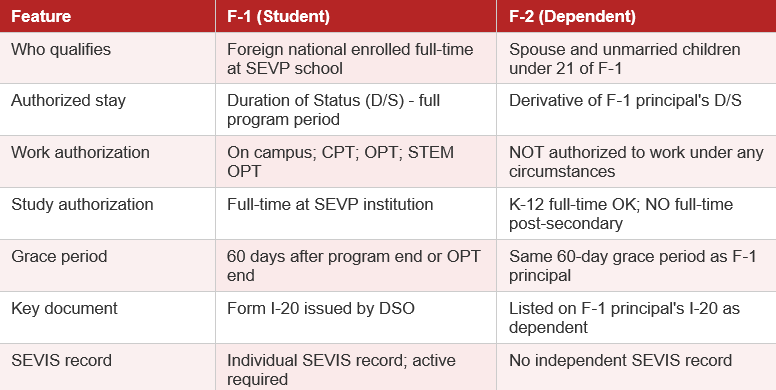
The F-1 visa is the most common US non-immigrant student visa, issued to foreign nationals who are accepted at and intend to enroll in a full-time academic program at a US Student and Exchange Visitor Program (SEVP)-approved institution. F-1 status covers undergraduate, graduate, language, and vocational programs. Unlike most US work visas, F-1 students are admitted for 'Duration of Status' (D/S) (this might change), meaning their authorized stay covers the entirety of their academic program, and have access to on-campus work authorization and program-based employment through CPT, OPT, STEM OPT.

F-1 status is self-regulating through the SEVIS system and DSO oversight. There is no USCIS petition required to maintain or extend F-1 status, and no separate extension application to USCIS as long as the student remains enrolled and in good standing. Status maintenance is primarily an institutional compliance matter managed through the school's DSO.
F-1 students have access to several forms of work authorization, each with specific eligibility requirements, application processes, and limitations. Unauthorized employment is one of the most serious F-1 status violations and can result in SEVIS termination, accrual of unlawful presence, and bars to future US admission. Students must ensure that any employment is properly authorized before beginning work.
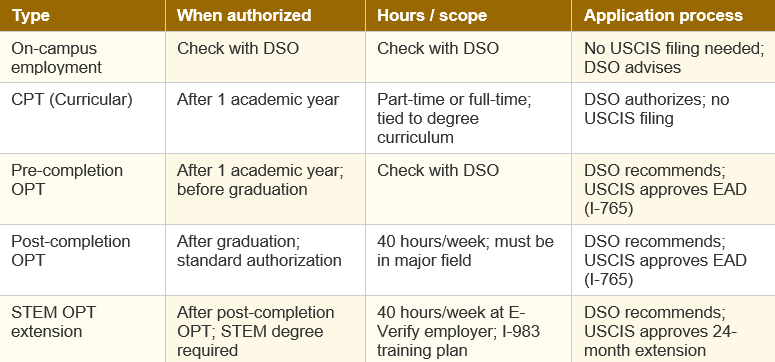
STEM OPT is a 24-month extension of post-completion OPT available to F-1 students who: have a degree in a STEM field designated on the DHS STEM Designated Degree Program List; are employed by an E-Verify participating employer; and have the employer complete a formal training plan (Form I-983) detailing the learning objectives and mentorship structure. STEM OPT extends the standard 12-month OPT period by 24 months, giving qualifying students up to 36 months of total OPT work authorization. The STEM OPT extension must be filed before the current OPT EAD expires.
An F-1 student may engage in activities for their own startup to the extent that those activities do not constitute unauthorized employment. Non-compensated activities such as forming the company, developing a business plan, others that are generally permissible under F-1 status. However, receiving compensation or equity as consideration for services, including founder salary or profit distributions, likely constitutes employment that requires authorization. F-1 students who wish to actively work on their startups while receiving compensation should seek CPT authorization (if the startup activity is tied to the curriculum), OPT authorization, or consult an immigration attorney about transitioning to a work-authorized status.
F-1 students do not file extension applications with USCIS. The F-1 program is extended through the DSO, who updates the SEVIS record and issues a new Form I-20 with an extended program end date. Maintaining valid F-1 status is an ongoing obligation throughout the academic program; violations can result in SEVIS termination and loss of status.
F-1 status maintenance is primarily a compliance matter between the student and their DSO. USCIS involvement is minimal during the academic period; the key government actors are DHS/ICE through SEVIS, the school's DSO, and CBP at ports of entry. Students should treat their DSO as their primary immigration advisor throughout their US studies.
F-1 students who wish to remain in the US after completing their studies in a work-authorized capacity must change to an appropriate non-immigrant or immigrant status. The most common transitions are to H-1B (professional employment), O-1 (extraordinary ability), or pursuing a green card through EB-1A or EB-2 NIW. F-1 students may also need to change to F-1 from another status if they enroll in a new academic program.
Changing status from F-1 to a work visa requires the new employer to file the appropriate petition (I-129 for H-1B, O-1, etc.) on the student's behalf. The student cannot self-petition for most work visas. OPT provides a critical bridge period between graduation and the October 1 H-1B start date, protected by the cap-gap rule.
Unlike most US non-immigrant visas where the I-94 specifies an exact expiration date, F-1 students are admitted for ‘Duration of Status’ (D/S). This means the student is authorized to remain in the US for the duration of their full-time academic program as listed on Form I-20, plus any authorized practical training period, plus a 60-day grace period after the program end date (or practical training end date). D/S does not mean unlimited stay; the student must maintain full-time enrollment and comply with all F-1 requirements throughout the program. Violations of status are tracked in the SEVIS system.
SEVIS (Student and Exchange Visitor Information System) is a DHS database that tracks F-1 and J-1 students and exchange visitors throughout their stay in the US. Each F-1 student has a SEVIS record maintained by their Designated School Official (DSO) at the US institution. SEVIS records must remain Active for the student to maintain valid F-1 status. A SEVIS record can be terminated for violations such as dropping below full-time enrollment without authorization, unauthorized employment, or failure to report changes to the DSO.
A Designated School Official (DSO) is a school administrator authorized by DHS to manage F-1 student records in SEVIS. Every SEVP-approved school must designate at least one DSO (the Primary DSO) and may designate additional DSOs. The DSO issues Form I-20, registers students in SEVIS, authorizes work permits such as CPT and OPT, issues travel signatures, updates student records when circumstances change, and advises students on maintaining F-1 status. Students must report any change in address, major, degree level, or expected program end date to their DSO promptly.
Both CPT (Curricular Practical Training) and OPT (Optional Practical Training) are work authorization programs for F-1 students, but they differ in keyways. CPT is authorized before graduation for internships, cooperative education programs, or work that is an integral part of the curriculum; it must be directly tied to the student’s degree program and must be authorized by the DSO. Full-time CPT of 12 months or more makes a student ineligible for post-completion OPT. OPT is authorized work experience in a field directly related to the student’s major area of study; it can be used before graduation (pre-completion OPT) or after graduation (post-completion OPT, the most common form). OPT is authorized for 12 months, with a potential 24-month STEM extension for eligible STEM degree holders.
Yes. F-1 students may transfer from one SEVP-approved school to another. The process involves: notifying the current school’s DSO of the intent to transfer; applying to and being accepted by the new school; working with both DSOs to transfer the SEVIS record; and enrolling at the new school within the program start date on the new I-20. Students must maintain continuous full-time enrollment; transfers that involve a gap in enrollment may raise status compliance concerns.