


The E visa category comprises two non-immigrant treaty-based visas: E-1 (Treaty Trader) for individuals and companies engaged in substantial international trade between the US and a treaty country, and E-2 (Treaty Investor) for individuals and companies that have made or are in the process of making a substantial investment in a real, operating US enterprise. Both categories are available exclusively to nationals of countries that have a qualifying commercial treaty or bilateral investment agreement with the United States.

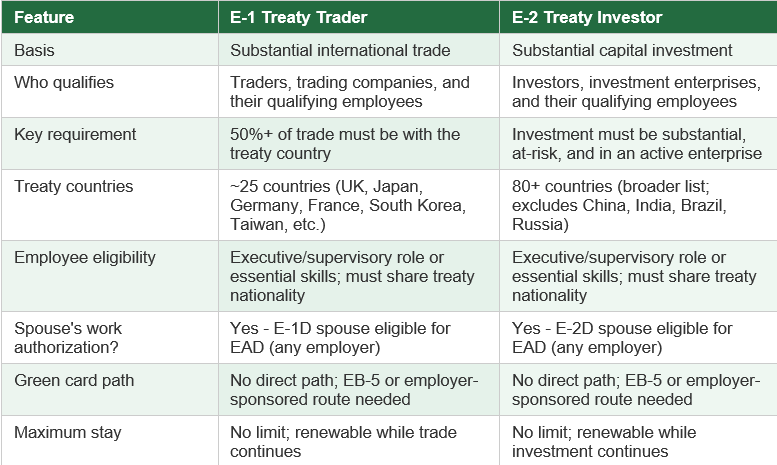
The E-1 visa is available to nationals of treaty countries who engage in substantial trade, principally between the United States and their home treaty country. Trade can be in goods, services, international banking, insurance, transportation, tourism, technology, or media. The applicant must demonstrate that over 50% of their total international trade is with the US. Employees of treaty trading companies may also qualify if they hold the treaty nationality, are employed in an executive, supervisory, or essential skills capacity, and are coming to the US to work for the treaty trading enterprise.
The E-2 visa is available to nationals of E-2 treaty countries who have invested, or are actively in the process of investing, a substantial amount of capital in a bona fide commercial enterprise in the United States. The investor must be coming to the US to develop and direct the enterprise. The investment must be at risk (committed and subject to loss), not marginal (capable of generating more than a bare living), and the investor must exercise real operational control over the business.
Key advantage: E visas are the only US non-immigrant visa category in which the basis for status is the investor's or trader's own economic activity, not an employer's petition on their behalf. The E visa holder is the principal, creating a uniquely self-directed immigration status tied to business performance rather than employment continuity.
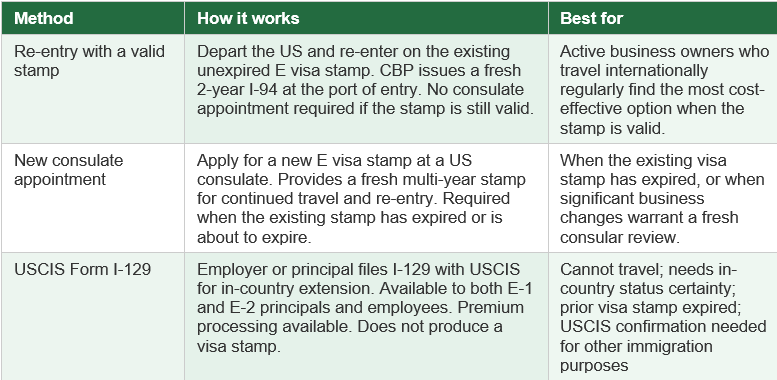
E-1 and E-2 visa stamps are typically issued for 5 years with multiple-entry validity (though the period varies by country under reciprocity agreements). The period of authorized stay in the US, set by the I-94 at each entry, is usually 2 years per admission, regardless of the visa stamp’s validity. There is no statutory maximum on total time in E status. Renewal options include: (1) departing the US and applying for a new visa stamp at a US consulate; or (2) filing Form I-129 with USCIS for an in-country extension, which does not produce a visa stamp. Each renewal requires a demonstration that the qualifying trade or investment activity continues.
Yes. There is no statutory limit on the number of E visa renewals or on total cumulative time in E status. As long as the treaty trader continues to engage in substantial trade with the treaty country, or the treaty investor continues to direct and develop the qualifying investment enterprise, renewals may continue indefinitely. This makes E status one of the most open-ended temporary work visa categories, contrasting sharply with H-1B (6-year cap) and L-1 (5- or 7-year cap).
At each renewal, whether at a consulate or through USCIS, the applicant must demonstrate that: the qualifying treaty trade (E-1) or investment enterprise (E-2) continues to exist and is actively operating; the trade continues to be substantial and principally between the US and the treaty country (E-1); the investment remains at risk and the investor continues to direct and develop the enterprise (E-2); the applicant continues to hold the required treaty nationality; and the applicant intends to depart the US when the authorized stay expires, unless otherwise authorized. Material changes in the nature of the business require an amended or new petition.
If the treaty enterprise undergoes a fundamental change, such as a change in ownership structure that affects treaty nationality, a change in the principal business activity, a merger or acquisition, or a significant change in investment amount, the E visa holder should consult an immigration attorney to determine whether the existing E status remains valid or whether an amended I-129 or new visa application is required. Continuing to operate under E status after a disqualifying change without notifying USCIS or reapplying is a status violation.
A national of a treaty country already present in the US in a valid non-immigrant status may change to E-1 or E-2 status by filing Form I-129 with USCIS. The applicant must meet all substantive E category requirements, qualifying nationality, qualifying trade or investment, and (for employees) executive, supervisory, or essential skills capacity. COS is processed by USCIS and does not require a consulate interview.
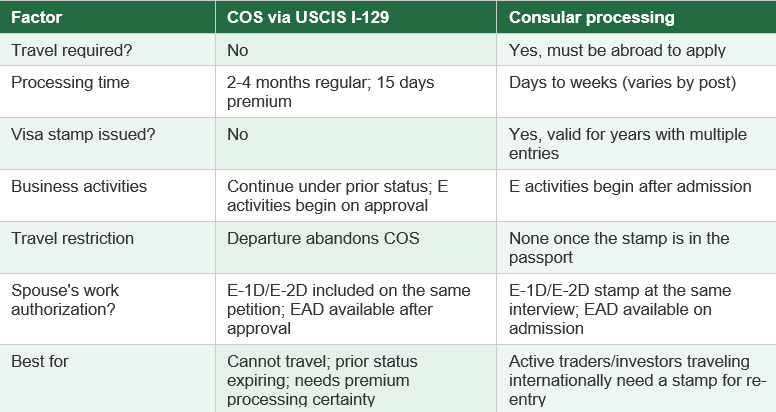
A USCIS-approved COS does not produce a visa stamp. E visa holders who travel internationally after a COS must obtain a new E visa stamp at a US consulate before re-entering the US. Business owners conducting international trade or investment activities who anticipate international travel should consider consular processing rather than COS to avoid operational interruptions.
Any foreign national of a treaty country currently in a valid non-immigrant status in the US may request a change of status to E-1 or E-2 by filing Form I-129 with USCIS. The applicant must meet all eligibility requirements: treaty nationality, qualifying trade (E-1) or investment (E-2), and, for employees, executive, supervisory, or essential skills capacity.
No. An approved I-129 COS changes status to E-1 or E-2 administratively without any departure or consulate visit. However, a COS approval does not produce a visa stamp. The E visa stamp is needed for re-entry after any international travel. E visa holders who travel abroad after a COS must obtain an E visa stamp at a US consulate before re-entering in E status. For business owners who travel internationally for trade or investment purposes, this is an important practical consideration.
If the applicant’s prior status authorizes business activities (e.g., H-1B, L-1, or TN authorizes employment), those activities may continue while the E COS petition is pending. It depends on case to case. Consult an immigration attorney.
COS via USCIS is advantageous when: the applicant cannot travel abroad; the applicant needs premium processing certainty (15 business days); there are consular backlog issues at the relevant post; or the applicant’s current status is expiring, and a USCIS extension provides a bridge. Consular processing is preferred when: the applicant will be traveling internationally for business in the near future (and needs a stamp); the applicant is outside the US; or the consulate is the primary E visa adjudicating post for that nationality (many treaty country nationals prefer consular processing for their initial E applications because the consulates have extensive experience with E applications).