The R-1 visa is a non-immigrant visa that allows members of a recognized religious denomination to work temporarily in the United States for a qualifying U.S. religious organization affiliated with that denomination. It covers ordained ministers, religious professionals, and individuals in recognized religious vocations such as monks, nuns, and deacons. R-1 is one of the few U.S. work visa categories with no annual cap, no prevailing wage requirement, and a direct pathway to a special immigrant green card (EB-4) without a PERM labor certification.
Core eligibility requirements
Denomination membership: Must have been a bona fide member of the petitioning denomination for at least 2 years immediately preceding the petition
Qualifying role: Must be a minister, religious professional, or worker in a recognized religious vocation or occupation
Qualifying employer: The petitioning U.S. organization must be a bona fide nonprofit religious organization (or a religious organization that is affiliated with the denomination and is exempt or qualifies for exemption under IRS Section 501(c)(3))
Compensation: Worker must receive a salary, stipend, housing, or other support commensurate with the religious vocation, unpaid volunteer work does not qualify
Temporary intent: R-1 is a non-immigrant category, though concurrent EB-4 green card pursuit is permitted in practice.
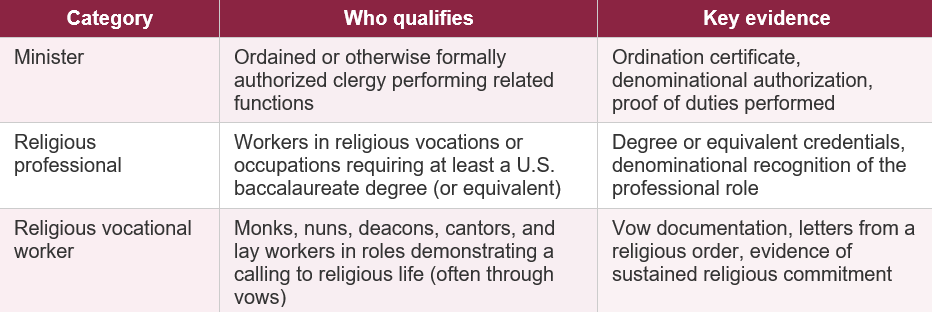
Categories of Qualifying Religious Worker
Unlike most employment-based categories, R-1 does not require the employer to test the U.S. labor market (no PERM), does not require a prevailing wage determination, and has no annual cap. These features make it the most accessible U.S. work visa for qualifying religious workers and their organizations.
Extension
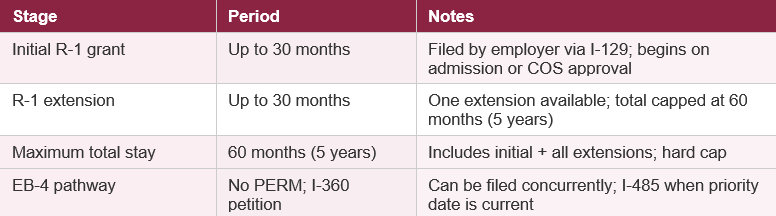
R-1 status may be extended once, for a total maximum stay of 5 years. The initial grant is up to 30 months (2.5 years); the extension is also up to 30 months. Extensions require the organization to re-file Form I-129 and demonstrate that the worker continues to perform qualifying religious duties and that the organization remains a bona fide qualifying religious entity. USCIS may conduct a new site visit in connection with an extension petition.
R-1 has a 5-year hard maximum. Workers approaching the limit who wish to remain in the U.S. long-term should pursue the EB-4 special immigrant religious worker classification through Form I-360 well before the R-1 clock expires. The I-360 has no PERM requirement and, once approved with a current priority date, allows the worker to file for adjustment of status (Form I-485) from within the US.
Extension Timeline and Limits
Change of status (COS) to R-1
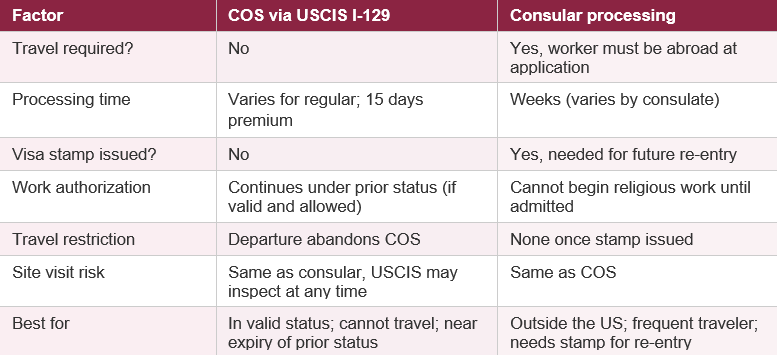
A foreign national already in a valid non-immigrant status in the U.S. may change to R-1 status through the religious organization filing Form I-129 with a COS request. This avoids the need to travel abroad for a consulate interview. The status change takes effect on the USCIS approval date shown on the I-797. The two-year denomination membership, qualifying role, and organizational requirements all apply in the same way as for consular processing.
COS approval does not produce a visa stamp. Workers who travel internationally for denominational activities, conferences, or personal reasons after a COS must obtain an R-1 visa stamp at a U.S. consulate before re-entering the U.S. in R-1 status. Plan ahead; appointment availability varies significantly by location.
COS Key Considerations
Must be in valid, unexpired non-immigrant status at the time of filing and throughout the pending period
Full eligibility requirements apply: 2-year denomination membership, qualifying religious role, bona fide IRS-exempt employer
Compensated religious work for the new employer cannot begin until the COS is approved (or prior status authorizes such work)
Departure during a pending COS abandons the status change; consular processing would then apply upon return
USCIS site visit may still occur after a COS approval; the organization must be prepared to substantiate all petition representations
Premium processing is available and is advisable when the worker’s current status is expiring soon
COS vs Consular Processing
Disclaimer: This document is for general informational purposes only and does not constitute legal advice. Immigration law is complex and subject to change. Consult a qualified immigration attorney at Kesar Law for guidance specific to your situation.