The P visa category covers athletes, entertainers, artists, and their essential support personnel who come to the United States temporarily to perform, compete, or teach. Unlike the O-1 visa, which focuses on extraordinary ability, the P visa focuses on group recognition, reciprocal exchange programs, and culturally unique performances. P visas have no annual cap, can be filed at any time, and are essential to the U.S. entertainment, sports, and cultural exchange sectors.
P Visa Overview
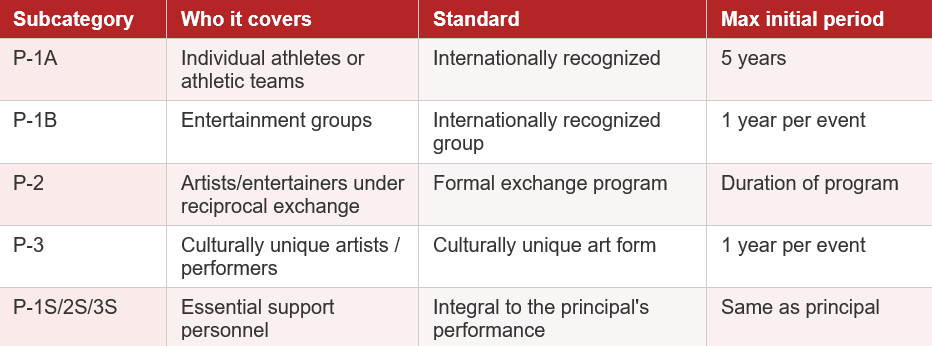
P-1A - International athletes
P-1A covers athletes who perform at an internationally recognized level of performance. This includes individual athletes, members of internationally recognized athletic teams, and athletes participating in the U.S. for a team that is part of an international league. The standard is international recognition, a high level of achievement in a sport, and recognition at the international level, which is generally more accessible than the O-1A extraordinary ability standard.
P-1B - Internationally recognized Entertainment Groups
P-1B applies to entertainment groups (bands, dance companies, theater troupes, circus acts, etc.) that are internationally recognized as outstanding in their discipline. International recognition must be attached to the group as an entity, not merely to individual members. At least 75% of the group must have performed together for at least one year, establishing the group's collective identity and body of work.
P-2 - Reciprocal Exchange Programs
P-2 applies to artists and entertainers (individually or as groups) who perform under a formal, government-recognized reciprocal exchange program between a U.S. organization and a foreign organization. The program must be reciprocal in nature: U.S. artists performing in foreign countries in exchange for foreign artists performing in the U.S. A petitioning U.S. organization must sponsor the program and demonstrate the formal exchange agreement.
P-3 - Culturally unique performers
P-3 applies to artists and entertainers who come to perform, teach, or coach in a program that is culturally unique, reflecting a unique or traditional ethnic, folk, cultural, musical, theatrical, or artistic tradition. P-3 is available to individuals or groups. The beneficiary need not be native to the cultural tradition but must demonstrate mastery and qualification to perform or teach it.
P-1S/P-2S/P-3S - Essential support personnel
Essential support personnel who accompany and assist P-1, P-2, or P-3 performers in a critical capacity may obtain P-1S, P-2S, or P-3S status. The support role must be integral to and essential to the performance, not merely convenient or preferred. Examples include coaches, choreographers, musical directors, and technical crew members whose specific expertise is required for the performance. Support personnel are petitioned for separately using the same I-129 form.
Key advantage: E visas are the only US non-immigrant visa category in which the basis for status is the investor's or trader's own economic activity, not an employer's petition on their behalf. The E visa holder is the principal, creating a uniquely self-directed immigration status tied to business performance rather than employment continuity.
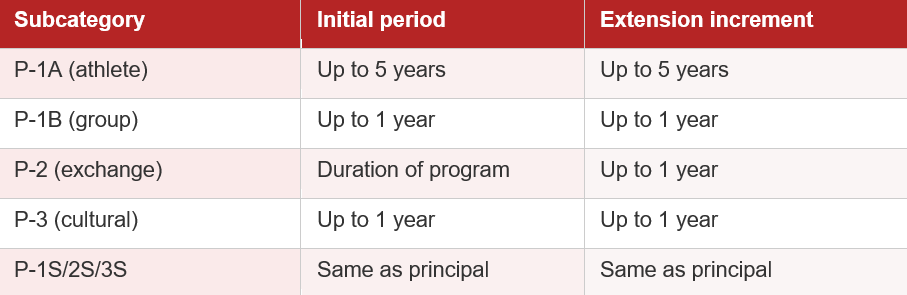
Extension
P visa extensions allow the beneficiary to remain in P status beyond the initial period approved by USCIS. The extension process follows the same I-129 petition framework as the initial petition. Extensions must be tied to continued performance in the qualifying P category and continued engagement with the petitioning employer or agent.
Extension Periods by Subcategory
Disclaimer: This document is for general informational purposes only and does not constitute legal advice. Immigration law is complex and subject to change. Consult a qualified immigration attorney at Kesar Law, LLC for advice specific to your situation.