
The O-1 visa is a non-immigrant visa for individuals who possess extraordinary ability in their field. Unlike most employment-based visa categories, O-1 does not require a specific degree or labor certification; it requires demonstrated extraordinary ability or achievement substantiated by sustained national or international acclaim. It is one of the most prestigious and flexible U.S. work visa categories, available to nationals of any country, with no annual cap.

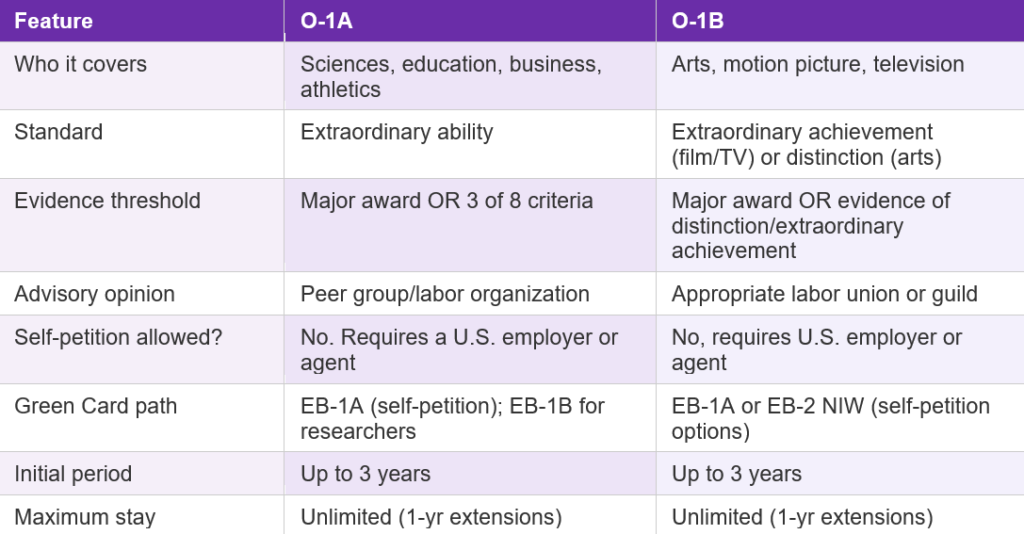
O-1A applies to individuals in the sciences, education, business, or athletics who have risen to the very top of their field. The standard is extraordinary ability evidenced by sustained national or international acclaim. The applicant must either receive a one-time major award (Nobel Prize, Pulitzer, Olympic medal, Academy Award) or demonstrate at least 3 of 8 regulatory criteria. USCIS applies a two-step analysis: first, evaluating whether the criteria are met, then conducting a final merits determination considering the totality of the evidence.
O-1B applies to individuals with extraordinary achievement in the motion picture or television industry, or to artists with distinction in the performing or visual arts. The arts standard (distinction) is somewhat lower than the O-1A extraordinary ability standard. The film and television standard (extraordinary achievement) is comparable to the O-1A standard and requires a very high degree of accomplishment.
Key advantage: O-1 is available to any nationality and any field with no cap, no lottery, and no labor certification. It is the premium non-immigrant category for established professionals and artists, and a direct precursor to EB-1A self-petition green card eligibility.
O-1 status may be extended in 1-year increments with no statutory maximum on total time in the U.S. Each extension requires the petitioner to demonstrate that the beneficiary continues to possess extraordinary ability or achievement, and that work in the qualifying capacity continues. Extensions are generally granted as long as the beneficiary remains active at an extraordinary level in their field.
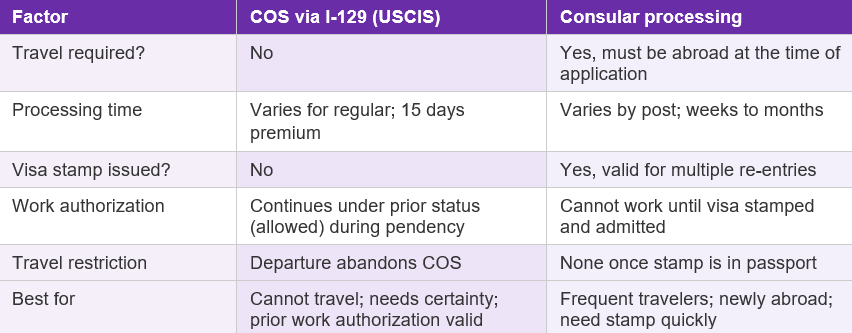
A foreign national already in the U.S. in a valid non-immigrant status may change to O-1 status through the employer or agent filing Form I-129 with a COS request. This eliminates the need to travel abroad for a consulate appointment. The status change takes effect on the approval date noted on the I-797.
COS to O-1 does not provide a visa stamp. The beneficiary will need to obtain an O-1 visa stamp at a US consulate before any international travel and re-entry. For beneficiaries who travel frequently, consular processing may be more practical than COS.