
The L-1 visa is a non-immigrant visa that allows multinational companies to transfer employees from a foreign affiliate, subsidiary, branch, or parent to a U.S. office. It comes in two categories: L-1A for managers and executives, and L-1B for employees with specialized knowledge. Each has different eligibility requirements, maximum stay periods, and immigration pathways.

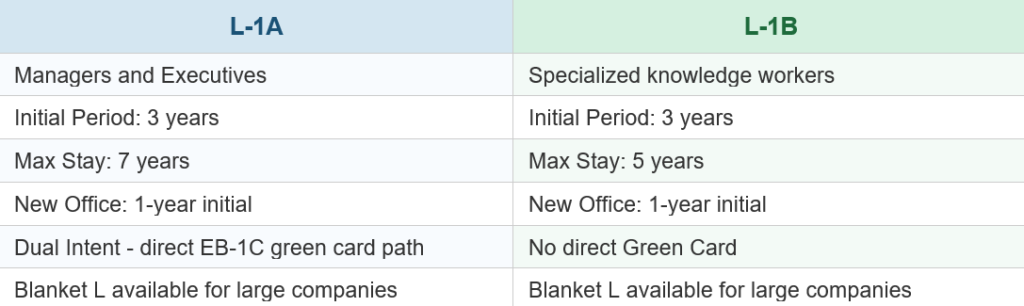
The L-1A category covers employees who have been employed abroad in a managerial or executive capacity and are being transferred to a similar U.S. role. Managers direct professional staff or manage the function of the organization. Executives direct the organization or a major component, receiving only general supervision from higher-level executives or a board.
The L-1B category covers employees possessing specialized knowledge of the company's products, services, research, equipment, techniques, management, or other proprietary interests. Specialized knowledge is distinct from general industry knowledge and not readily available in the US labor market.
Key distinction: L-1A holders can obtain an EB-1C green card (no PERM labor certification required), making it a faster route to permanent residence. L-1B holders must typically use EB-2 or EB-3 categories, which require PERM and are subject to longer waits.
L-1 extensions allow continued employment beyond the initial period. Both L-1A and L-1B extensions require the employer to file a new I-129 petition demonstrating that the qualifying organizational relationship and the nature of the role continue to satisfy L-1 requirements. USCIS re-adjudicates each extension petition fully.

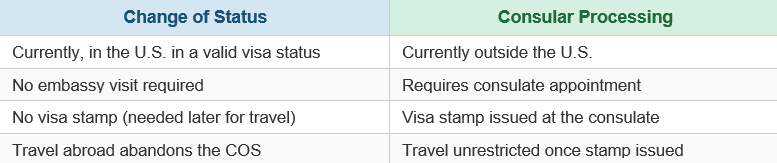
A foreign national already in the US in a valid non-immigrant status may request a change of status to L-1 as part of the employer's I-129 petition. This avoids the need to leave the US and attend a consular interview. The status change takes effect on the approval date noted on the I-797 notice.
Note: Changing status to L-1 does not provide a visa stamp. A stamp is required to re-enter the US after any international travel. Plan any necessary consular appointments before departing if a trip is anticipated.
A qualifying relationship exists when the U.S. and foreign entities are related as parent, branch, subsidiary, or affiliate. The relationship must exist at the time of the petition and throughout the authorized stay.
No. Unlike the H-1B, L-1 visas are not subject to an annual numerical cap or lottery. Petitions can be filed at any time of year, and approved workers can begin employment as soon as USCIS approves the petition (or the visa stamp is issued for consular cases).
If the U.S. entity has been doing business for less than one year, the petition is treated as a new office petition. The initial period is limited to one year rather than three. The extension must demonstrate that the business has grown to support a managerial, executive, or specialized knowledge role as described in the petition.
Yes. Spouses and unmarried children under 21 are eligible for L-2 dependent visas. L-2 spouses are eligible to work; no separate EAD is required, though an EAD can be obtained as proof for employers. L-2 children are not work-authorized.
Large multinationals meeting certain criteria may file a Blanket L petition. This pre-approves the qualifying relationship, allowing employees to transfer more quickly using a simpler consular process without individual I-129 filings.